I’m eight weeks into running Inteum, and I’ve never been this productive in my life.
Not “productive” in the LinkedIn sense. I mean the actual sense. The volume of thinking I can put through a day is higher. The structure of my direction to the team is tighter. The quality of what I write, decide, and ship is better than at any point in my thirty-year career. I am not working longer hours. I am working fewer. I keep catching myself wondering whether the three-day work week some people are predicting might actually be real, just not for the reasons most people are arguing about.
Here is what’s underneath it.
What it actually looks like to run a company through AI
I’ve set up a Claude project space for the entire operation of the business. It has folders for product strategy, people and talent, partnerships, cultural artifacts, top customers, financial rhythm, and board prep. In my first eight weeks, I met every one of our top customers. I took notes by hand in every meeting. I do not use transcription tools when a customer is opening up to me. It changes the room. I want them looking at a person, not a microphone.
After each meeting, I photographed those handwritten pages and sent them to Claude. Claude reads my handwriting with what feels like 100% accuracy, which is a breakthrough I still cannot quite believe. Across dozens of conversations,, Claude surfaces patterns I would have spotted eventually, but not the same afternoon. The insights are still mine. The themes are still mine. What changed is the speed at which I can see them and act on them.
For internal meetings, I use Sembly. It takes the notes so I can run the meeting. My follow-ups go out the same day. I’m no longer the bottleneck on my own decisions.
This is what being an AI power user looks like in 2026. Not a chatbot that you ask occasional questions. An operating system you run your life and your company through.
And this is also the most dangerous moment of my career as a leader.
The feedback that stopped me cold
Because my team did not get the same upgrade.
About six weeks in, I got the feedback. Direct, honest, exactly the kind of feedback a new CEO needs and rarely gets this early. My output was “overwhelming.” This stopped me cold. I had been operating in what I thought were kid gloves. I was holding back. I was deliberately throttling what I sent, what I asked for, the pace of decisions, the volume of strategy work I put into the system. And it was still too much.
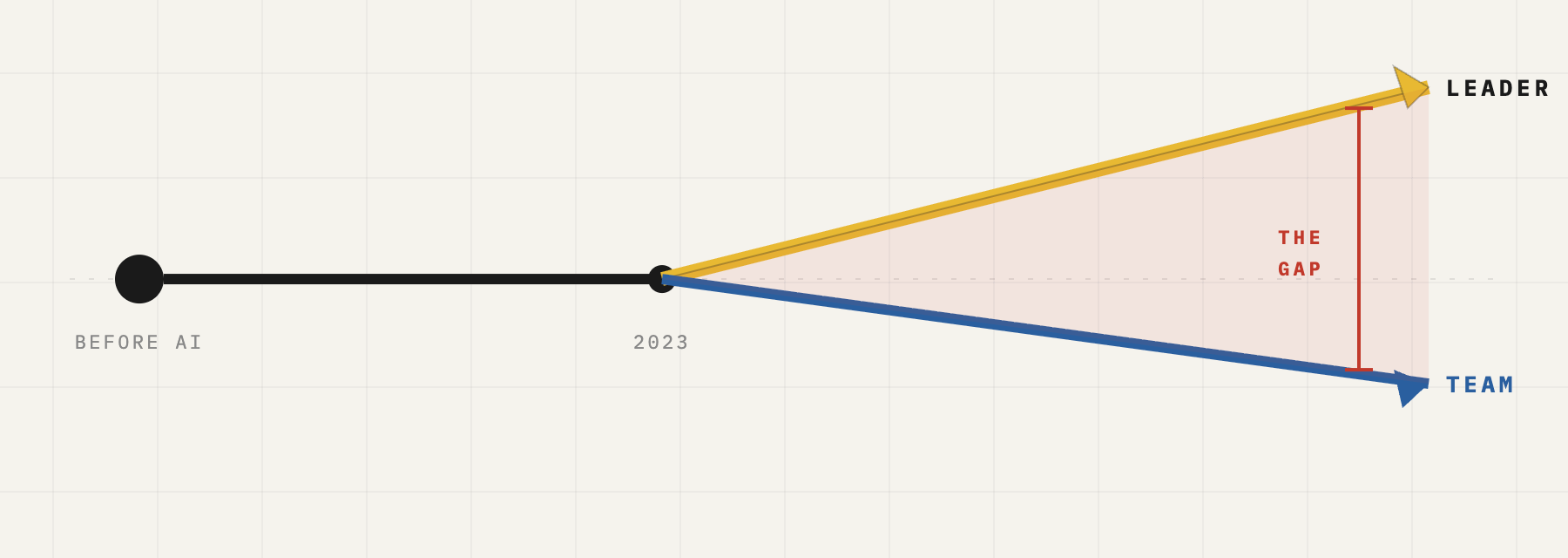
That was the moment I realized the gap was real and that I had walked into it without noticing.
How two-speed teams form
This is how two-speed teams form. Quietly. Without anyone deciding to create one. The leader gets the AI upgrade. The team doesn’t. The leader, even on their best, most thoughtful day, sends more, asks more, ships more. The team reads it and thinks the bar moved. Because functionally, it did. The pace of inbound from the CEO is higher. The pace of decisions is higher. The pace of expected response is higher, even if the leader never said the word “faster” once. They feel it. And the ones who are not yet AI-first feel it the most.
Why the foundation matters more than the tool
I learned to think in documents at Amazon Web Services, before AI was a thing. PowerPoint was banned. Every meeting started with a written narrative. Six pages, read in silence at the start of the meeting, then discussed. The discipline of writing was the discipline of thinking. You could not hide bad thinking inside a bullet point because there were no bullet points. I have written about the two mechanisms I learned there that still shape how I run a company. The PRFAQ for product thinking. The WBR for operational discipline. Both are narrative tools. Both force clarity by removing the hiding place of vague thinking.
I owe my entire operating system to that time at Amazon, and I am more convinced of it now than I was then. AI did not teach me to write or think. It amplified a muscle I spent years building. The tool sits atop the foundation. Without the foundation, the tool is just a faster way to produce more confused work.
This is the part most leaders miss. The lift you are getting from AI is not coming from the tool. It is coming from the thinking the tool is sitting on top of. If you give the same tool to a team member who never built that muscle, you do not get the same lift. You get a frustrated person staring at a blank prompt, or worse, a confident person shipping confident nonsense.
The same pattern is playing out in engineering.
I see the same pattern in engineering.
The senior developers I talk to are having the time of their lives. They’ve spent 15 to 20 years writing clean code, designing systems, reasoning about trade-offs, and refactoring other people’s mistakes. They know what good looks like. When they hand a coding agent a well-scoped problem, they get extraordinary output back, and they know how to read it, test it, harden it, and ship it. Their productivity has not doubled. It has gone up by an order of magnitude on certain kinds of work.
The junior developers, and a lot of the unstructured middle, are not getting the same lift. Note that this is not an observation of my team, but a general one I have noticed from some clients I have advised. Some are getting worse. They’re skipping the muscle-building phase. They’re shipping code that they cannot explain. They’re losing the reps that turn a coder into an engineer. The tool is the same. The foundation is different. The output is wildly different. And the gap between the seniors and everyone else is widening on the same team, in the same codebase, in the same week.
This is the two-speed team in a different uniform. Same dynamic.
What history tells us about new tools
The instinct to “just roll AI out to everyone” is not the answer. It helps, but it does not close the gap. AI adoption inside a team is not a tools rollout. It is a thinking rollout. Some people get there in three months. Some in a year. Some never get there in the same way. Your job as a leader is not to drag them. Your job is to redesign the flow of work so your new velocity does not become their burnout.
When I started at Sony in the early 90s, before the PC was common in the office, before email, before the internet, we would write a memo by hand and send it to the typist pool. They would type it, print it, and deliver it to physical inboxes on people’s desks. When the PC arrived with WordPerfect, the typists told me the same thing every time. “This is going to take our jobs.” Some of them were right about themselves. They were not right about the technology. The smart ones learned the PC and the word processor and moved into roles that did not exist before. Executive assistants. Office managers. Operations leads. The ones who refused to learn were not replaced by the PC. They were replaced by the person next to them who learned the PC.
This is the part of the AI conversation that gets lost in the noise. AI is not taking anyone’s job. A person using AI might. That has always been how this works. It worked that way with the PC. It worked that way with the internet. It worked that way with mobile. It is working that way now, faster than on any previous shift.
What I’m trying to do, imperfectly
If you are an AI-first leader running a team in 2026, here is what I am trying to do, in real time, imperfectly.
Slow the inbound. Just because I can write three strategy memos before lunch does not mean I should send three strategy memos before lunch. Most of what I generate is thinking out loud. I keep it for me until it’s ready.
Be explicit about what a draft is and what a decision is. The team can no longer tell the difference. The polish is too high on both. So I label everything. “Draft, not a decision.” “Decision, please execute.” “Thinking out loud, no action.”
Invest in the team’s early adopters. Every team has them. Find them. Give them space, time, and air cover to figure out their own version of what you are doing. They will pull the rest along faster than any training program.
Stop measuring your productivity as a personal stat. Your productivity is now a leadership variable. If your speed is creating a wake the team is drowning in, that is not productivity. That is a problem you created.
And maybe most importantly. Be honest with the team about what is happening. The gap is real. Pretending it isn’t makes it worse. The reason I got the “overwhelming” feedback at week six is that I had built a team culture where someone could tell me. That feedback was a gift. If I had not heard it, I would have kept accelerating into a wall the team was already hitting.
The leadership problem of the next five years
The question about the three-day work week is interesting. I’m not convinced it’s coming for everyone. But for the people who learn this craft properly, I think something close to it is already here. And the gap between them and everyone else is the most important leadership problem of the next five years.
I am trying to lead through it, not race ahead of it. How do you think about this? I remain curious!