I’ve spent 30 years in tech, shaping how people work. Sony Handycam. Windows Mobile. Microsoft Office. I helped start Office 365, built search, including Bing, led at AWS, and was Xero’s first Chief Product Officer.
I’ve seen many hype cycles from the inside, which gives me perspective on new innovations.
So when I tell you a $30 screen protector changed how I work, I mean it; it stands out against a backdrop of technology hype I’ve seen before.
I was there for the tablet’s original vision.
This category has been trying to happen for a long time.
In 1989, GRiD Systems launched what many see as the first portable tablet. It was mocked. Apple’s Newton MessagePad was ahead of its time and yet frustrating in equal measure. I owned one. AT&T’s EO Personal Communicator was another miss.
Then Microsoft had its turn. In 2001, I was an early adopter of the Tablet PC. The vision was right. The execution wasn’t.
Hardware wasn’t ready. Handwriting recognition was unreliable. Batteries were limited. Microsoft tried to fit Windows everywhere, rather than truly rethink tablets. The device felt more like a laptop with a pen than something new.
I still credit Microsoft with inventing the modern tablet. Jeff Raikes, who led the effort, had real vision. Tablet computing’s time was coming, but Microsoft couldn’t ship it right.
Apple did what Microsoft couldn’t. They didn’t shrink a desktop OS; they started fresh for touch and built a fitting ecosystem. The iPad wasn’t just better, it was a new vision for tablets.
And for years, I still mostly used mine to read news and watch movies.
The organizational problem
It’s not by accident. Years in productivity software gave me strong views on structure. I organize everything by Tiago Forte’s PARA system: Projects, Areas, Resources, Archives. I’ve tried most tools; this one works with all of them.
I worked on SharePoint. I helped ship enterprise search. I know firsthand how hard it is to build software that helps people find what they’re looking for. So I’m not easy to impress when it comes to knowledge management tools.
Notion. Evernote. Bear. Obsidian. I keep coming back to Apple Notes.
That probably sounds like a failure of imagination. It isn’t. Apple Notes has come a long way. If you’re in the Apple ecosystem, take a serious look at it before subscribing to something more complex. The search is fast. The sync is invisible. Your notes are just there, on every device, without you having to think about it. I know where my notes are, whether I’m on my iPhone at a café or on my iPad at home. That reliability is underrated.
I’ve tried Kindle Scribe and reMarkable. Both are interesting, but poor search, friction from managing a separate device, and weak sync make the Apple ecosystem hard to beat.
The hardware that finally made the iPad essential
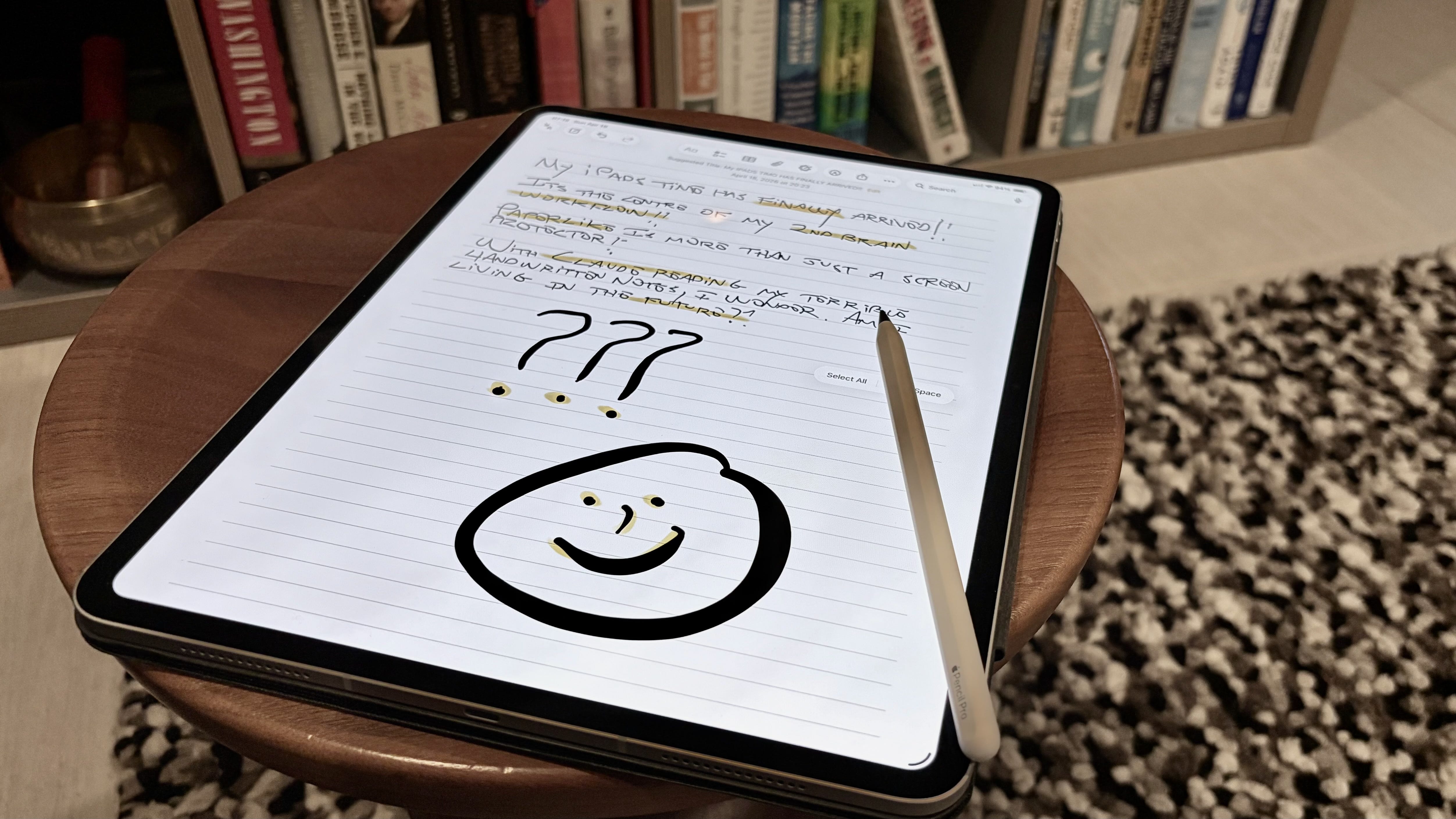
The iPad Air is genuinely impressive hardware. But what unlocked it for me was Paperlike. It’s a screen protector with a slightly textured surface that makes writing with the Apple Pencil feel like a pen on paper. They also make custom pencil tips designed for the surface.
It sounds like a small thing. It isn’t.
Before Paperlike, iPad writing felt slippery. Now, I want to handwrite. I use Apple Pencil for almost all notes—35 years after GRiD’s first try.
The 1989 vision finally works, after decades, new software, and a $30 screen protector.
The AI piece
Here’s where it gets genuinely interesting. I have terrible handwriting. Always have.
Didn’t matter.
Each week, I send my handwritten iPad notes to Claude. Claude reads with near-perfect accuracy, summarizes my week, extracts action items, and spots patterns. For someone who thinks better writing than typing, it’s a true unlock.
I spent years building search and knowledge management products at Microsoft. We worked hard to help people find things they’d already written down. What AI can do now with unstructured handwritten input would have seemed impossible in that era. It still kind of amazes me.
There’s another shift underway: voice recognition has finally arrived.
Voice recognition never worked well with my accent, which is somewhere between New Zealand and American. Now, it does.
Now it does. Close to 100% accuracy in iOS and most apps. I reply to emails by voice. I send texts. I take notes. I worked on Windows Mobile back when voice input was a parlor trick. The distance between that and what’s in my pocket today is hard to overstate.
Which makes me think about what comes next.
The keyboard has been the primary input mode for computing for over 50 years. We’ve accepted it so completely that we barely question it. But I’m starting to wonder if that’s changing. Not because of the AR headset demos and vision videos showing people gesturing at floating holograms in a loft apartment. Those have always felt like science fiction dressed up as product strategy.
Voice is here, and works. I use it in cafés, on walks, or while driving. No new devices or habits needed.
The keyboard isn’t going away tomorrow. But I think we’re closer to a world where it’s optional than most people realize. Handwriting for thinking. Voice for communicating. Touch for navigating. The keyboard is one tool among several, rather than the default assumption.
That’s not a vision video. That’s just my Tuesday.
I’ve watched several platform shifts from the inside. The PC. The internet. Mobile. Cloud. Each one felt significant while you were living through it, and each one created new categories of products and new ways of working that nobody fully predicted in advance.
What strikes me about where we are now is how much value is showing up in the small moments. Not in a keynote. Not in a product launch. In a screen protector that makes your handwriting useful. In software that reads your notes better than you can. In voice recognition that finally works for an accent like mine.
These things compound. The iPad went from something I reached for occasionally to the center of how I work. That happened through a dozen small improvements, not one big one.
I wonder what’s coming around the corner. I always do. After 30 years, that feeling hasn’t worn off. If anything, the pace makes it more interesting.
I’ve been lucky to have a front-row seat for this long. I’m aware that access to this kind of technology is not evenly distributed. I don’t take it for granted.
But when it works, it really works