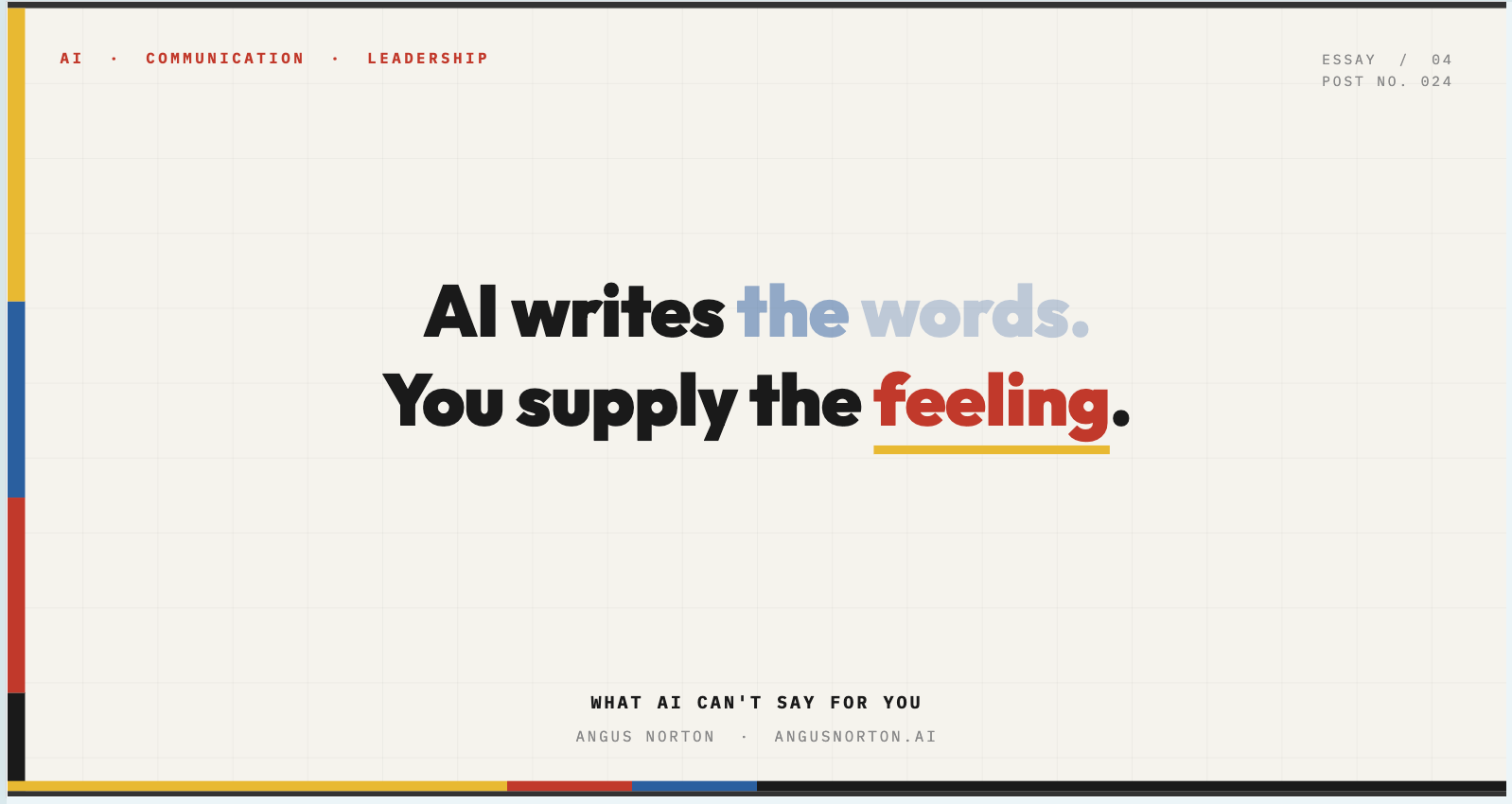
People don’t remember what you said. They remember how you felt.
That line comes from Charles Duhigg on a recent episode of Finding Mastery, the podcast hosted by my friend Michael Gervais. If you don’t know Michael’s work, you should. He’s a high-performance psychologist who has spent his career studying how the best in the world think, from Olympic athletes to Super Bowl teams to Fortune 50 CEOs, and Finding Mastery is where he puts that work into the open. I’ve been listening for years and sharing his episodes for almost as long, because the conversations consistently get at something most business content misses. The human underneath the performance. This particular episode, his third with Duhigg, is about what makes someone a great communicator, and one idea in it stopped me.
Duhigg’s point is that if you ask people what they talked about in an hour-long conversation, they remember almost nothing specific. But ask them how they felt during it, and they can walk you through every shift. Good at the start. Worse in the middle when one thing got said. The words evaporate. The feeling stays.
I’ve been thinking about that line in the context of my last post, where I wrote about the AI productivity gap and how much more I produce now than I ever have. Because it points directly at the limit of all that production. Duhigg makes a related point from the communication side. In a world where AI can make any email sound thoughtful, polish and fluency no longer mean what they used to. We arrived at the same place from different doors.
The half AI is brilliant at
I use AI to manage the knowledge that runs through my work and my life. I’ve said that plainly. It helps me capture, organize, synthesize, and sharpen almost everything that flows across my desk. My memos are clearer. My follow-ups are faster. My thinking gets to a shareable shape in an afternoon instead of a week.
All of that lives on one side of Duhigg’s line. The what. The content. The words people will not remember.
AI is extraordinary at the words. It will give you the clearest, most complete, most professionally worded version of almost anything you need to say. And here is the trap. That version is good. It reads well. It looks like communication. Which makes it easy to believe the job is done when the message is well written.
But the part people actually carry, the how did you make me feel part, is not in the words. It never was. And it’s the one thing no tool can produce for you.
Why my team always hears my values first
Whenever I start with a new team, the first thing I do is tell them what I stand for. Not the company values on a wall. Mine. The things I actually use to make decisions when the situation is hard and the answer isn’t obvious.
I don’t do this to convert anyone. I don’t expect a team to adopt my values or live by them. People arrive with their own, shaped by their own lives, and that’s exactly as it should be. What I’m doing is simpler and, I think, more useful. I’m telling them the truth about how I operate, up front, before anything goes wrong, so that when a hard moment comes they already know where I’ll stand. It removes the guesswork. It tells them what to expect from me and gives them the right to hold me to it.
Because values you only talk about are not values. They’re slogans. The whole point is that you say them out loud and then you live them, especially when it costs you something. A team can forgive almost anything except a leader whose stated values and actual behavior don’t match. That gap is the fastest way to lose people. So I’d rather be clear about a small number of real ones and then prove them in how I act than impress anyone with a long list I don’t honor.
Two of mine matter most. Family first. And one I call swings and roundabouts, the idea that there are seasons when we work flat out and seasons when you close the laptop early and go be with the people who matter, and that it all evens out over time. I don’t say these once and file them away. I repeat them. I make decisions in front of the team that visibly come from them. By the time anyone really needs me to live those values, they’ve already watched me do it a dozen times in smaller ways.
The half that’s still entirely on you
Earlier in my career, long before any of these tools existed, someone on my team was going through something I won’t fully describe, out of respect for them. They had lost their partner to a long illness. The circumstances of that loss had shaken their faith, the kind of faith that had organized their whole life until then. They were a proud person who didn’t put their private life in front of others, and I could tell they were holding something back.
There was no message to draft here. No memo. The only thing that mattered was whether this person felt heard.
So I listened. I put myself in their shoes and told them I had been somewhere similar in my own life. And then I acted on my values, the same ones I’d laid out for the team the day I arrived. This person needed time. They needed a new place to stand, a new geography, a chance to reset their life. Family first and swings and roundabouts weren’t abstractions in that moment. They were the exact instructions for what to do. I was in a position to give this person what they needed, and I did.
I could move fast on that, decisively, without it ringing hollow. Not because I found the perfect words. Because I had done the slow work long before that conversation. I had figured out what I believe and said it out loud. When the moment came, I didn’t need to compose a response. I needed to live one I’d already written, in how I’d chosen to lead.
Same architecture, higher stakes
In the last post I made a simple argument. The lift you get from AI isn’t coming from the tool. It’s coming from the thinking the tool sits on top of. Give the same tool to someone without the foundation and you don’t get the same result.
Connection works the same way. The message sits on top of the human. AI can make the message faster, cleaner, more polished. It cannot supply the human underneath it. It cannot supply the values you defined before you needed them, the history that lets you say “I’ve been there,” the judgment to know when someone needs words and when they need you to stop talking and just be present.
The danger isn’t that AI communicates badly. It’s that it communicates so well on the surface that we forget the surface was never the part that mattered. We optimize the forgettable half and feel productive doing it. Meanwhile the half people will actually remember, the way we made them feel, gets less of us, not more.
The discipline this asks for
I’m not arguing against using AI for communication. I use it constantly and I’m not stopping. I’m arguing for knowing which half you’re working on.
When the goal is clarity, structure, getting a complex thought into a shape people can react to, let the tool do what it’s great at. Use the time it gives back.
But when the goal is connection, when someone needs to feel heard, seen, valued, or simply not alone, that time you saved is exactly what you spend. You put the laptop down. You stop optimizing the words. You do the human thing that no model can do for you, because it was never about the words in the first place.
The people I’ve led over the years won’t remember the wording of much I ever sent them. I hope some of them remember how it felt to work with me. That part was never going to come from a machine, in any era. It was only ever going to come from me.
Thank you to Michael for the conversation that sent me down this road, and for years of conversations before it. If you want the full hour, it’s worth your time.
Listen: The Psychology of Being a Super Communicator with Charles Duhigg on Finding Mastery More from Michael: findingmastery.com